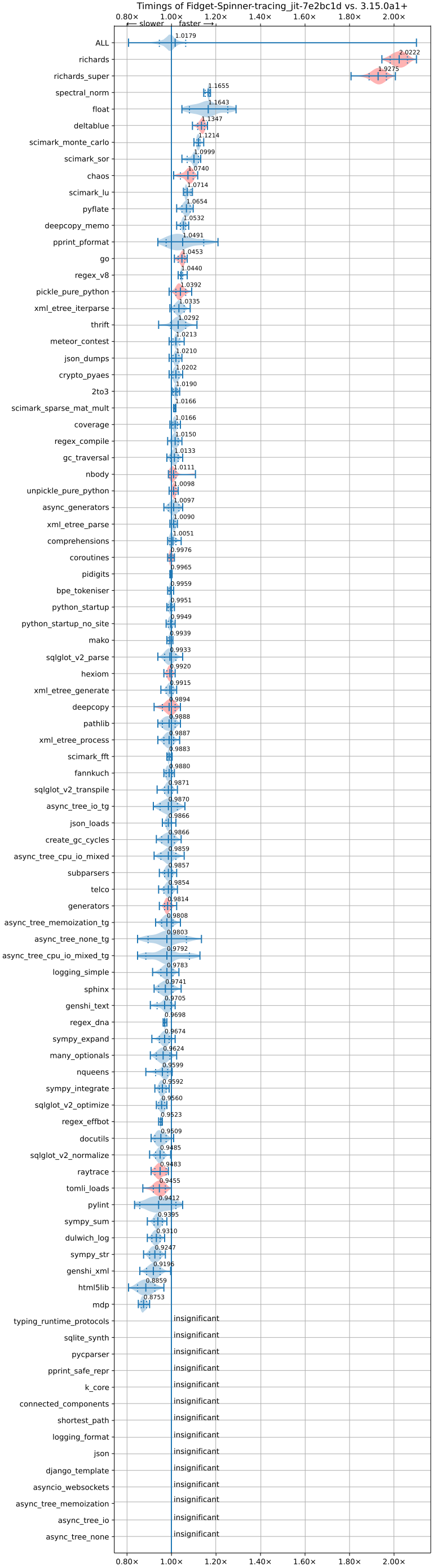
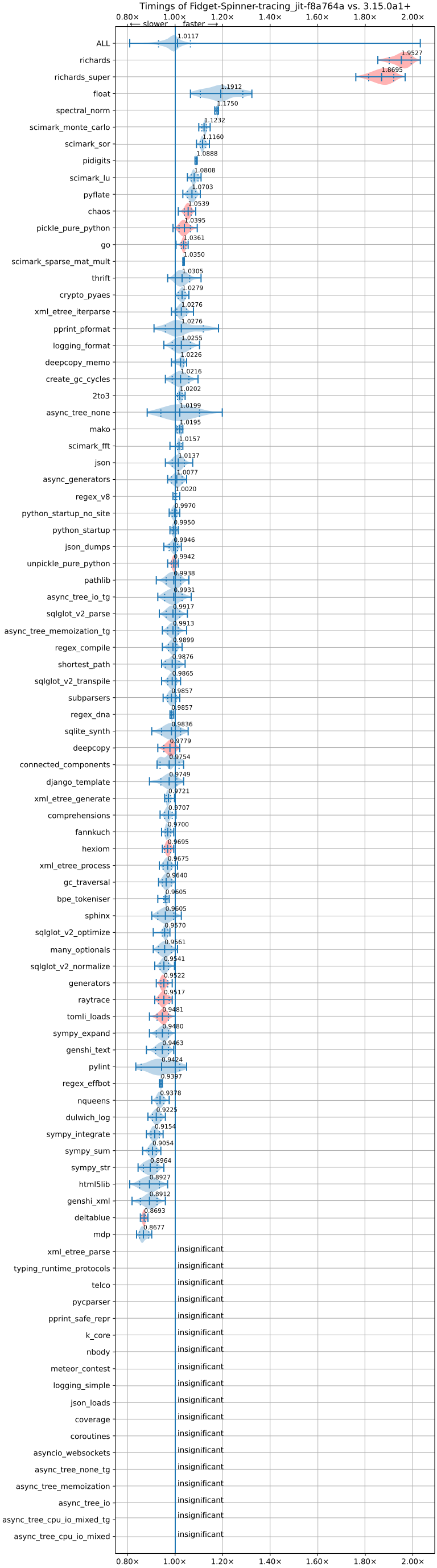
This PR changes the current JIT model from trace projection to trace recording. Benchmarking: better pyperformance (about 1.7% overall) geomean versus current https://raw.githubusercontent.com/facebookexperimental/free-threading-benchmarking/refs/heads/main/results/bm-20251108-3.15.0a1%2B-7e2bc1d-JIT/bm-20251108-vultr-x86_64-Fidget%252dSpinner-tracing_jit-3.15.0a1%2B-7e2bc1d-vs-base.svg, 100% faster Richards on the most improved benchmark versus the current JIT. Slowdown of about 10-15% on the worst benchmark versus the current JIT. **Note: the fastest version isn't the one merged, as it relies on fixing bugs in the specializing interpreter, which is left to another PR**. The speedup in the merged version is about 1.1%. https://raw.githubusercontent.com/facebookexperimental/free-threading-benchmarking/refs/heads/main/results/bm-20251112-3.15.0a1%2B-f8a764a-JIT/bm-20251112-vultr-x86_64-Fidget%252dSpinner-tracing_jit-3.15.0a1%2B-f8a764a-vs-base.svg

Stats: 50% more uops executed, 30% more traces entered the last time we ran them. It also suggests our trace lengths for a real trace recording JIT are too short, as a lot of trace too long aborts https://github.com/facebookexperimental/free-threading-benchmarking/blob/main/results/bm-20251023-3.15.0a1%2B-eb73378-CLANG%2CJIT/bm-20251023-vultr-x86_64-Fidget%252dSpinner-tracing_jit-3.15.0a1%2B-eb73378-pystats-vs-base.md .

This new JIT frontend is already able to record/execute significantly more instructions than the previous JIT frontend. In this PR, we are now able to record through custom dunders, simple object creation, generators, etc. None of these were done by the old JIT frontend. Some custom dunders uops were discovered to be broken as part of this work gh-140277

The optimizer stack space check is disabled, as it's no longer valid to deal with underflow.

Pros:
* Ignoring the generated tracer code as it's automatically created, this is only additional 1k lines of code. The maintenance burden is handled by the DSL and code generator.
* `optimizer.c` is now significantly simpler, as we don't have to do strange things to recover the bytecode from a trace.
* The new JIT frontend is able to handle a lot more control-flow than the old one.
* Tracing is very low overhead. We use the tail calling interpreter/computed goto interpreter to switch between tracing mode and non-tracing mode. I call this mechanism dual dispatch, as we have two dispatch tables dispatching to each other. Specialization is still enabled while tracing.
* Better handling of polymorphism. We leverage the specializing interpreter for this.

Cons:
* (For now) requires tail calling interpreter or computed gotos. This means no Windows JIT for now :(. Not to fret, tail calling is coming soon to Windows though https://github.com/python/cpython/pull/139962

Design:
* After each instruction, the `record_previous_inst` function/label is executed. This does as the name suggests.
* The tracing interpreter lowers bytecode to uops directly so that it can obtain "fresh" values at the point of lowering.
* The tracing version behaves nearly identical to the normal interpreter, in fact it even has specialization! This allows it to run without much of a slowdown when tracing. The actual cost of tracing is only a function call and writes to memory.
* The tracing interpreter uses the specializing interpreter's deopt to naturally form the side exit chains. This allows it to side exit chain effectively, without repeating much code. We force a re-specializing when tracing a deopt.
* The tracing interpreter can even handle goto errors/exceptions, but I chose to disable them for now as it's not tested.
* Because we do not share interpreter dispatch, there is should be no significant slowdown to the original specializing interpreter on tailcall and computed got with JIT disabled. With JIT enabled, there might be a slowdown in the form of the JIT trying to trace.
* Things that could have dynamic instruction pointer effects are guarded on. The guard deopts to a new instruction --- `_DYNAMIC_EXIT`.
Add PyUnstable_ThreadState_SetStackProtection() and
PyUnstable_ThreadState_ResetStackProtection() functions
to set the stack base address and stack size of a Python
thread state.

Co-authored-by: Petr Viktorin <encukou@gmail.com>
There were a few thread-safety issues when profiling or tracing all
threads via PyEval_SetProfileAllThreads or PyEval_SetTraceAllThreads:

* The loop over thread states could crash if a thread exits concurrently
  (in both the free threading and default build)
* The modification of `c_profilefunc` and `c_tracefunc` wasn't
  thread-safe on the free threading build.
Move PYOS_LOG2_STACK_MARGIN, PYOS_STACK_MARGIN,
PYOS_STACK_MARGIN_BYTES and PYOS_STACK_MARGIN_SHIFT macros to
pycore_pythonrun.h internal header. Add underscore (_) prefix to the
names to make them private. Rename _PYOS to _PyOS.
For several builtin functions, we now fall back to __main__.__dict__ for the globals
when there is no current frame and _PyInterpreterState_IsRunningMain() returns
true.  This allows those functions to be run with Interpreter.call().

The affected builtins:

* exec()
* eval()
* globals()
* locals()
* vars()
* dir()

We take a similar approach with "stateless" functions, which don't use any
global variables.
In the free-threaded build, avoid data races caused by updating type
slots or type flags after the type was initially created.  For those
(typically rare) cases, use the stop-the-world mechanism.  Remove the
use of atomics when reading or writing type flags.
* FOR_ITER now pushes either the iterator and NULL or leaves the iterable and pushes tagged zero

* NEXT_ITER uses the tagged int as the index into the sequence or, if TOS is NULL, iterates as before.
Removed special-casing for WASI when setting C stack depth limits. Since WASI has its own C stack checking this isn't a security risk.

Also disabled some tests that stopped passing. They all happened to have already been disabled under Emscripten.
* Track the current executor, not the previous one, on the thread-state.

* Batch executors for deallocation to avoid having to constantly incref executors; this is an ad-hoc form of deferred reference counting.
In the free-threaded build, avoid data races caused by updating type slots
or type flags after the type was initially created.  For those (typically
rare) cases, use the stop-the-world mechanism.  Remove the use of atomics
when reading or writing type flags.  The use of atomics is not sufficient to
avoid races (since flags are sometimes read without a lock and without
atomics) and are no longer required.
Improve the error message with a suggestion when an object supporting the synchronous
(resp. asynchronous) context manager protocol is entered using `async with` (resp. `with`)
instead of `with` (resp. `async with`).
Only disable SLP autovectorization of `_PyEval_EvalFrameDefault` on newer
GCCs, as the optimization bug seems to exist only on GCC 12 and later, and
before GCC 9 disabling the optimization has a dramatic performance impact.
Mark a few functions used by the interpreter loop as noinline

These are all the slow path and should not be inlined into the interpreter
loop. Unfortunately, they end up being inlined with LTO and the current PGO
task.
The SLP autovectorizer can cause poor code generation for opcode dispatch, negating any benefit we get from vectorization elsewhere in the interpreter loop.
Implements a workaround implementation of `pthread_get_stackaddr_np` for Emscripten.
This will be replaced by an implementation that will be included in Emscripten 4.0.6.